Showing posts with label 1928-29. Show all posts

Friday, March 13, 2015

Madame X (1929)


Nominated for 2 Academy Awards:
Best Directing
Lionel Barrymore
Best Actress
Ruth Chatterton
It won 0 Oscars out of a total of 2 nominations in 1928-29.


Madame X is Jacqueline Floriot, a woman who spends her life running away from her past as an adulterous outcast, until she finally commits a heinous murder in order to silence a man who intends to reveal her sins.  An inexperienced, young lawyer is appointed as her public defender and it becomes his mission to garner sympathy for this woman as he is simultaneously unaware of the mysterious connection that the two of them share.

It is based on the play by Alexandre Bisson.


Although this is a sound film, there is no music during the opening credits or end titles.  This is because, at the time, studios were still expecting individual theaters to provide their own musicians to perform during these portions of the movie.


Editorial:

Backtracking.  This hard-to-find film has now been reviewed after being put on hold.

It is absolutely tragic that this movie is horrifically boring for more than two-thirds its length, because the final half-hour is actually deeply engaging.  Putting aside a longer-than-needed setup, once the murder occurs, the story and performances pick up significantly.

Ruth Chatterton's courtroom scene is a fantastic showcase for her talent, and the underlying message of attempting to understand those who commit villainous acts is a noble endeavor.  Unfortunately, it takes so painfully long to get there.

Score  |  04/10  |  This motion picture is worth trying.

Tuesday, March 10, 2015

The Letter (1929)


Nominated for 1 Academy Award:
Best Actress
Jeanne Eagels
It won 0 Oscars out of a total of 1 nomination in 1928-29.


The Letter follows Leslie Crosbie, who is a lonely woman that has become involved in an affair with a man named Geoffrey Hammond.  While her husband is away, she lures Hammond to her home and brutally murders him after learning that he has been living with a Chinese woman.  A single letter, however, must be bought and suppressed, or her guilt will otherwise be made public.

It is adapted from the play by W. Somerset Maugham.


Jeanne Eagels tragically died of a drug overdose shortly after the completion of this film, thus becoming the first actress to receive a posthumous Academy Award nomination.

Once considered a lost film, a workprint was rediscovered and placed back into circulation in 2011.


Editorial:

Backtracking.  This hard-to-find film has now been reviewed after being put on hold.

This particular film is both absolutely preposterous and unforgivably racist.  While one can certainly comprehend a corrupt justice system that would garner sympathy for a maddened Caucasian woman, this movie weaves a world that simply could never exist in which the presence of a Chinese person only offers an opportunity for stereotypes to strangle any ounce of worth this film may have had.  The worst part is that a performance by Jeanne Eagels that could have been memorable for the sake of its performance becomes memorable for all of the wrong reasons.

Score  |  01/10  |  This motion picture is definitely not worth watching.

Sunday, March 8, 2015

Weary River (1929)


Nominated for 1 Academy Award:
Best Directing
Frank Lloyd
It won 0 Oscars out of a total of 1 nomination in 1928-29.


Weary River begins when Jerry Larrabee and his gang shoot an innocent bystander.  Even though the boys decide that it would be in their best interest to lay low for a while, Larrabee is pinched and the Court mandates that he serve from one to ten years in prison.  Insistent on not taking the rap, he becomes an uncontrollable prisoner until he gets wise and finally finds the outlet his soul desires:  musicianship.  But can a convict really become The Master of Melody?

Frank Lloyd lost the Academy Award for directing this film to himself for directing another film in the same year;  The Divine Lady (1929).


This film was produced partially as a silent film with title cards and partially as a sound film with audible dialogue, as production occurred during the industry's transition to talkies,  The existing print is preserved with the Library of Congress and was a joint restoration project of the Library of Congress Motion Picture, Broadcasting and Recorded Sound Division, the UCLA Film and Television Archive, and Warner Bros. / Turner Entertainment Company.

Richard Barthelmess does not provide vocals for the film's title track, "Weary River," that is performed throughout the film.  Instead, his singing was dubbed by that of lesser-known actor, Johnny Murray, who had planned on loaning his voice to Richard Barthelmess again in the future, had Barthelmess ever decided to star in another musical.


Editorial:

Backtracking.  This hard-to-find film has now been reviewed after being put on hold.

This film suffers from a massive identity crisis in terms of medium.  Producing a film in which silent scenes are inter-cut with sound scenes could possibly make for an interesting way to experience a film, but the purposelessness of how this movie does it feels borderline schizophrenic.

On top of this, the story seems to scratch the poignant surface of a social issue in which a culture is unwilling to recognize convicted criminals as reformed citizens, but  wastes the opportunity and instead nosedives into the melodramatic.  It really could have been something more than it actually was.

Score  |  03/10  |  This motion picture may be worth trying.

Friday, March 6, 2015

The Hollywood Revue (1929)


Nominated for 1 Academy Award:
Best Picture
M-G-M
It won 0 Oscars out of a total of 1 nomination in 1928-29.


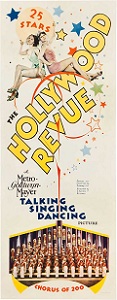
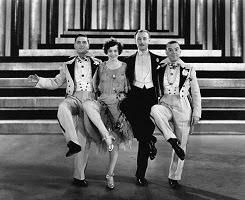
The Hollywood Revue, or The Hollywood Revue of 1929, is a film recording of a variety show presented by Masters of Ceremonies, Jack Benny and Conrad Nagel, featuring Metro-Goldwyn-Mayer's most famous studio contract players billed as their Galaxy of Stars.  This theatrical stage show features musical numbers, sketches and vaudeville acts from the Albertina Rasch Ballet Company, Nils Asther, Lionel Barrymore, the Brox Sisters, James Burrows, Joan Crawford, Dane and Arthur, Marion Davies, Marie Dressler, Cliff "Ukulele Ike" Edwards, Gus Edwards, John Gilbert, William Haines, Buster Keaton, Beth Laemmle, Laurel and Hardy, Gwen Lee, Bessie Love, the M-G-M Chorus, Myrtle McLaughlin, Polly Moran, Natova and Company, Anita Page, June Purcell, the Rounders, and Norma Shearer.

The two notable holdouts from MGM are Greta Garbo and Lon Chaney.  Both were expected to appear in the film, but Garbo opted to use Anna Christie (1930) as a vehicle for her sound film debut, and Chaney requested to be paid his regular salary which could not feasibly be done with the production budget.


The movie features three segments that were filmed in Technicolor, all of which survive to this day.  The first segment is a spoof of the balcony scene from William Shakespeare's "Romeo and Juliet" featuring Lionel Barrymore, John Gilbert and Norma Shearer.  The second segment is the musical number "Orange Blossom Time" featuring Charles King, Myrtle McLaughlin and the Albertina Rasch Ballet Company.  The third segment is the final musical number, a reprise of "Singing in the Rain" performed by the ensemble cast - notable for being the first film recording of this particular song.  Initially, some screenings would fill the theater with an aroma of orange blossoms to accompany "Orange Blossom Time," but this experience was short-lived after numerous patrons suffered allergic reactions.

The cinematic classic Singin' in the Rain (1952) - a satire of the transition from silent films to talkies - drew inspiration and was heavily influenced by this particular film.  It famously borrowed its title and opening number from the Technicolor finale.  But in addition to this, it also played upon silent film star, John Gilbert's, unsuccessful attempt to continue working in sound films after his disastrous high-pitched performance as Romeo in the parody of the "Romeo and Juliet" balcony scene.


Editorial:

Backtracking.  This hard-to-find film has now been reviewed after being put on hold.

There seems to be little affection for this unique picture that arrived at the dawn of sound films, which is probably due to the excess of stale jokes and the inability of some famous silent stars to break into the world of sound films.  It also has the misfortune of its Vitaphone sound discs no longer existing, causing the left-side of the screen to be cropped and the entire film to be framed off-center.

Honestly, though, this is actually quite a great concept that MGM was willing to run with.  Instead of deciding to piecemeal each individual star into a talkie to see if audiences would embrace their newly discovered voices, this movie took virtually all of the studio's major contract actors and placed them into one vehicle to introduce them as potential talkie players to the public as a whole.  The result is actually quite pleasant, as it became a production filled with so many stars that otherwise may have never appeared together.  Displaying their intelligence on the matter, they would also allow Buster Keaton to retain his status as a silent star and merely make an appearance, as if to say, "he is still The Great Stone Face and he always will be."

Score  |  06/10  |  This motion picture is worth watching.

Sunday, February 1, 2015

Our Dancing Daughters (1928)


Nominated for 2 Academy Awards:
Best Writing
Josephine Lovett
Best Cinematography
George Barnes
It won 0 Oscars out of a total of 2 nominations in 1928-29.


Our Dancing Daughters offers a commentary on the decline of youthful morality as the story centers around the saintly Diana (the Dangerous) and her friendship with a gold-digging woman named Ann.  The two both fancy a well-known football player from Alabama, and the pivotal question becomes who will ultimately win his heart.

This film helped catapult Joan Crawford to superstardom.


While this film does not feature any audible dialogue, it was synchronized for sound and utilized instrumental music, song recordings and sound effects.


Editorial:

It is certainly easy to understand how this was Joan Crawford's breakout performance, as she is easily one of the most memorable elements of this picture.  There are also many beautiful interior shots and even more gorgeous exterior shots, providing high quality production design.

Though Crawford may or may not have gone completely insane by the end of her career, her beauty and on-screen charisma are undeniable.

Score  |  03/10  |  This motion picture may be worth trying.

Tuesday, March 6, 2012

Alibi (1929)


Nominated for 3 Academy Awards:
Best Picture
Feature Productions
Best Actor
Chester Morris
Best Art Direction
William Cameron Menzies
It won 0 Oscars out of a total of 3 nominations in 1928-29.


Alibi is a crime melodrama about an ex-convict named Chick Williams who rejoins the mob after being released from prison.  He soon, however, becomes the prime suspect when a policeman is murdered, and is protected only by an alibi that involves the National Theatre, a dizzy dame and an undercover officer posing as an alcoholic stockbroker.

The film was based on a Broadway stage play entitled "Nightstick."


A silent version of the film was released at the same time as the sound version and reportedly contains alternative scenes that were shot especially for it.


Editorial:

This movie seemed very experimental.  There are a lot of visually interesting moments peppered throughout, but are unfortunately overlooked by the poor sound recording.  The dialogue is hard to hear most of the time, the sound effects are abnormally loud and the distracting noise picked up by the microphones remains constant.

Much of it feels like a silent film with how it is staged, but the portions of long-winded and stale conversation make it evident that this is an artifact from the early days of talkies.  The silent version may be of interest considering the quality of the sound version.

Score  |  04/10  |  This motion picture is worth trying.

Sunday, January 15, 2012

White Shadows in the South Seas (1928)


Winner of 1 Academy Award:
Best Cinematography
Clyde De Vinna
It won 1 Oscar out of a total of 1 nomination in 1928-29.


White Shadows in the South Seas takes us to the last remnant of an earthly paradise in the coral atolls of the South Pacific where white men are attempting to bring civilization to the native peoples.  A lone doctor, however, becomes ashamed of his race after witnessing the exploitation of the natives for the sake of acquiring precious pearls, and is ultimately shunned.  Finding himself marooned on an untouched isle, he is greeted as a "white god" by the indigenous tribe and becomes romantically involved with an island woman.  But temptation leads to terror when the good doctor must confront his own humanity and greed for pearls.


The film is based on the novel by Frederick O'Brien and actually cited as being a "camera record" of the book.  It was indeed filmed on location and primarily used islanders as actors in the film - though it must be noted that it was shot in Tahiti and not in Marquesas, as the credits state.

Most interestingly, this movie is famous for being the first MGM film with a pre-recorded soundtrack and, thus, the first MGM film to feature the sound of their trademark lion roaring at the beginning.


Editorial:

This movie is a well-done adventure-romance that is incredibly photographed and, almost as a bonus, offers up a social commentary on "civilizing" indigenous tribes.

It must definitely be recognized that the plot of this film has, to date, been completely overdone - formulating itself into such recent incarnations as Dances with Wolves (1990), Pocahontas (1995) and Avatar (2009) - to name a few.  Though this does make it insanely predictable, it is still a very enjoyable experience.  It is technically well-done and, considering the period in which the film was released, extremely refreshing.

Score  |  07/10  |  This motion picture may be essential viewing.

Thursday, January 5, 2012

A Woman of Affairs (1928)


Nominated for 1 Academy Award:
Best Writing
Bess Meredyth
It won 0 Oscars out of a total of 1 nomination in 1928-29.


A Woman of Affairs centers around the exploits of a gallant lady named Diana and the path of destruction paved by her tragic romance with childhood sweetheart, Neville.  Although the two have vowed their love for one another, Neville flees to Egypt in order to garner wealth and protect his father's honor.  Growing impatient, Diana ultimately marries faithful rower, David, at the insistence of her hero-worshiping brother and, in doing so, triggers a chain of events surrounding death and deceit.


The film is actually based on a play entitled "The Green Hat," but severed all ties from its source material by changing the title and character names.  Such changes were made due to the controversial subject matter in the play.  In addition to that, cuts were made from the original script in order to appease the censors - most notably, the unexplained reason for Diana's illness, which was (according to the script and presumably the original play) due to a miscarriage.

Despite these concerns, it would place itself in the ranks of the top twenty box office draws of 1929.


Editorial:

Suspenseful, provocative, dark and edgy, the film takes twists and turns that are both gripping and unpredictable.  Although, at times, it can be a little over-the-top, it is - at the very least - entertaining.  Its boldness is much appreciated and, even though the ending is completely ridiculous, it works well.

Score  |  05/10  |  This motion picture may be worth watching.

Tuesday, January 3, 2012

The Divine Lady (1929)


Winner of 1 Academy Award:
Best Directing
Frank Lloyd
Nominated for 2 Academy Awards:
Best Actress
Corinne Griffith
Best Cinematography
John F. Seitz
It won 1 Oscar out of a total of 3 nominations in 1928-29.


The Divine Lady is the story of the love and destiny of England's greatest beauty and England's greatest sailor.  Set amidst the dawn of the French revolution, a cook's daughter transforms from being an unpolished gem into a rare jewel after playing a pivotal role in the ongoing war efforts.

This film accomplished the extremely rare feat of winning an Academy Award for Directing without having also been nominated for Best Picture.


The film's theme song, "Lady Divine," would go on to become quite a popular tune in 1929 and would be covered by numerous artists.


Editorial:

This film is standard fare for the time, presenting a narrative arc based around a "love conquers all" ideal.  Story-wise, it was a little lackluster.  However, the periodic occurrences of naval battles and mob riots were engaging enough.  The overall production quality was impressive enough, which seemed to strive for an epic scope - even if it was only mildly successful.

Score  |  03/10  |  This motion picture may be worth trying.

Friday, April 8, 2011

Coquette (1929)


Winner of 1 Academy Award:
Best Actress
Mary Pickford
It won 1 Oscar out of a total of 1 nomination in 1928-29.


Coquette is a drama of the American South about a flirtatious southern belle and the company she keeps.  After winning the heart of a gentleman that her father disapproves of, the couple defies the father's wishes and plans to marry.  Discovering their intentions, a confrontation turns ugly, and a death sentence awaits someone.  But can the testimony of a little coquette save this person, or bring him to justice?

Reports say that Mary Pickford was accused of "unfairly" winning her Academy Award by strongly lobbying for it and using her status in the industry to sway voters.  It must be noted that, despite these claims, she was critically acclaimed for her performance at the time.


This was the first talkie for silent film star, Mary Pickford, and it allowed her to successfully transition into sound films after the picture was a box office success.


Editorial:

This movie works in the same fashion as a play, which makes sense, as it was based on a play.  But as a film, it deviates away from a lot of conventions that are so attached to storytelling through films.

The best example I can give is this:  most of the action takes place in the home of Mary Pickford's character.  Even when there are two critical events in the story-line that take place elsewhere - the cabin of her suitor - they are never shown.  Despite their significance to the plot, they are merely alluded to through dialogue between the characters at the coquette's home.  At first, it seemed that it was simply impossible to secure the set for these cabin scenes, but this does not appear to be the case, as the cabin setting appears later in the film.  As a viewer, this is confusing.  The film could be a lot more interesting had they shown the two scenes that seemed worth watching.

Score  |  03/10  |  This motion picture may be worth trying.

Tuesday, April 5, 2011

In Old Arizona (1928)


Winner of 1 Academy Award:
Best Actor
Warner Baxter
Nominated for 4 Academy Awards:
Best Picture
Fox
Best Directing
Irving Cummings
Best Writing
Tom Barry
Best Cinematography
Arthur Edeson
It won 1 Oscar out of a total of 5 nominations in 1928-29.


In Old Arizona is a western that follows notorious outlaw, the Cisco Kid.  After robbing a stagecoach, an army sergeant pursues the bandit in hopes of obtaining the $5,000.00 reward for his head.  A secret romance, however, turns to betrayal when the Kid's seƱorita wants in on the action.

Credited as the first sound western, it was also the first talkie to be filmed outdoors.


Raoul Walsh was originally cast in the lead role and set to direct the picture, but was forced to drop out after sustaining injuries in an automobile accident.  Driving from Utah to California, a jackrabbit - believe it or not - jumped through the windshield of Walsh's car.  Broken glass gashed his right eye, which he would ultimately end up losing, causing him to start wearing the eye-patch that he was so famous for.

Because of the accident, director Irving Cummings was brought in to work on the project, with Warner Baxter in the lead role.  Walsh and Cummings would take co-director credits on the film, but it was only Cummings that the Academy ended up nominating for Best Directing.

A few distance shots of Walsh as the Cisco Kid also made it into the film, as well.


Editorial:

This was, indeed, a compelling story that was done really well.  Baxter gives an outstanding performance, and the photography is great.  Although the slow pace of the second act causes the film to drag, the first and third acts are very engaging.  With such a satisfying resolution, complaints are minimal.

As a viewer, one must wonder how much of the film was directed by Walsh and how much of it was directed by Cummings.  Warren Baxter is on-screen through most of the film, so the bulk of it was obviously done by Cummings.  But which shots were done by Walsh?  Quite curious.

Score  |  07/10  |  This motion picture may be essential viewing.

Monday, April 4, 2011

The Broadway Melody (1929)


Winner of 1 Academy Award:
Best Picture
M-G-M
Nominated for 2 Academy Awards:
Best Directing
Harry Beaumont
Best Actress
Bessie Love
It won 1 Oscar out of a total of 3 nominations in 1928-29.


The Broadway Melody is an all-talking, all-singing, all-dancing dramatic sensation that centers around a song-and-dance man who commissions a vaudeville sister act to appear in his Broadway revue.  Behind-the-scenes, a wealthy suitor courts the younger sister of the musical duo, creating tension and jealousy among the talented threesome.

It was the first musical and the first sound film to win the Academy Award for Best Picture.


Originally, the film's sequence featuring the song "The Wedding of the Painted Doll" was presented in Technicolor on a two-color track.  This helped initiate a trend for movie musicals to feature color sequences, which would continue for some years later.  Unfortunately, the Technicolor sequence in The Broadway Melody is presumed lost, and only a black-and-white copy is known to exist at this time.


Editorial:

It is easy to beat up on this film.  There seems to be a general consensus that it is one of the least deserving Best Picture winners in Academy history.  But there is a reason as to why it won.  The novelty of sound at the time probably gave it incredible momentum in terms of commercial appeal.

It was certainly groundbreaking, and it did set the stage for all of the sound films - especially musicals - that followed.  But that alone cannot save the film from unquestionable mediocrity.  Without being too harsh, it does come off as rather dull and silly.  The musical numbers were few and far between, seaming together a senseless story about a showbiz love triangle that was both prolonged and ridiculous.  That being said, it was a pioneer of the genre.

Score  |  03/10  |  This motion picture may be worth trying.

Thursday, March 3, 2011

Street Angel (1928)


Winner of 1 Academy Award in 1927-28:
Best Actress
Janet Gaynor
Nominated for 2 Academy Awards in 1928-29:
Best Cinematography
Ernest Palmer
Best Art Direction
Harry Oliver
It won 1 Oscar out of a total of 1 nomination in 1927-28.
It won 0 Oscars out of a total of 2 nominations in 1928-29.


Street Angel is the story of a young woman who is arrested for robbery and soliciting herself on the streets when she finds herself in desperate need of money.  To avoid a one-year sentence in the workhouse, she flees the city and joins a vagabond in his traveling show, eventually falling in love with a painter.  But after she sustains an injury and the two decide to settle down together, she must come face-to-face with her troubled past.


The film holds a special place in Academy history.  It is the first of fifteen films to be competitively nominated in two separate years - the others being The Quiet One (1948), Through a Glass Darkly (1961), The Four Days of Naples (1962), Sundays and Cybele (1962), Marriage Italian Style (1964), The Umbrellas of Cherbourg (1964), Woman in the Dunes (1964), The Shop on Main Street (1965), The Battle of Algiers (1965), My Night at Maud's (1969), Investigation of a Citizen Above Suspicion (1970), The Emigrants (1971), Day for Night (1973) and Amarcord (1973).   Three additional films have been able to accomplish this feat non-competitively:  Snow White and the Seven Dwarfs (1937), In Which We Serve (1942) and Rashomon (1950).

This is quite unusual to occur, and it is unclear as to why it actually happened in this instance.


Editorial:

I joke about this film a lot, but in all fairness, it is really well done.  It was not the best of Janet Gaynor's three performances that contributed to her Oscar win, but she does a great job in it.  It is a charming, sweet story with good production value.  Perhaps it is a little predictable, and a pretty safe approach to the subject matter at hand, but I have very few complaints.

Score  |  04/10  |  This motion picture is worth trying.